

Birds: Albatross
In Herman Melville’s classic novel, Moby Dick, Melville spends an extraordinary amount of time on every subject. In his chapter on the Whiteness of the Whale, the book’s narrator, Ishmael, talks at length about the Goney, which is a seaman’s name for an albatross. Sometimes called the wandering sea bird, as made famous by Coleridge’s Rhyme of the Ancient Mariner, there are four different species in the “wandering albatross complex:” Snowy, Tristan, Antipodean and Amsterdam. There are twenty other species of Albatross, one of which, the Laysan Albatross, is described later in this Witness Post.
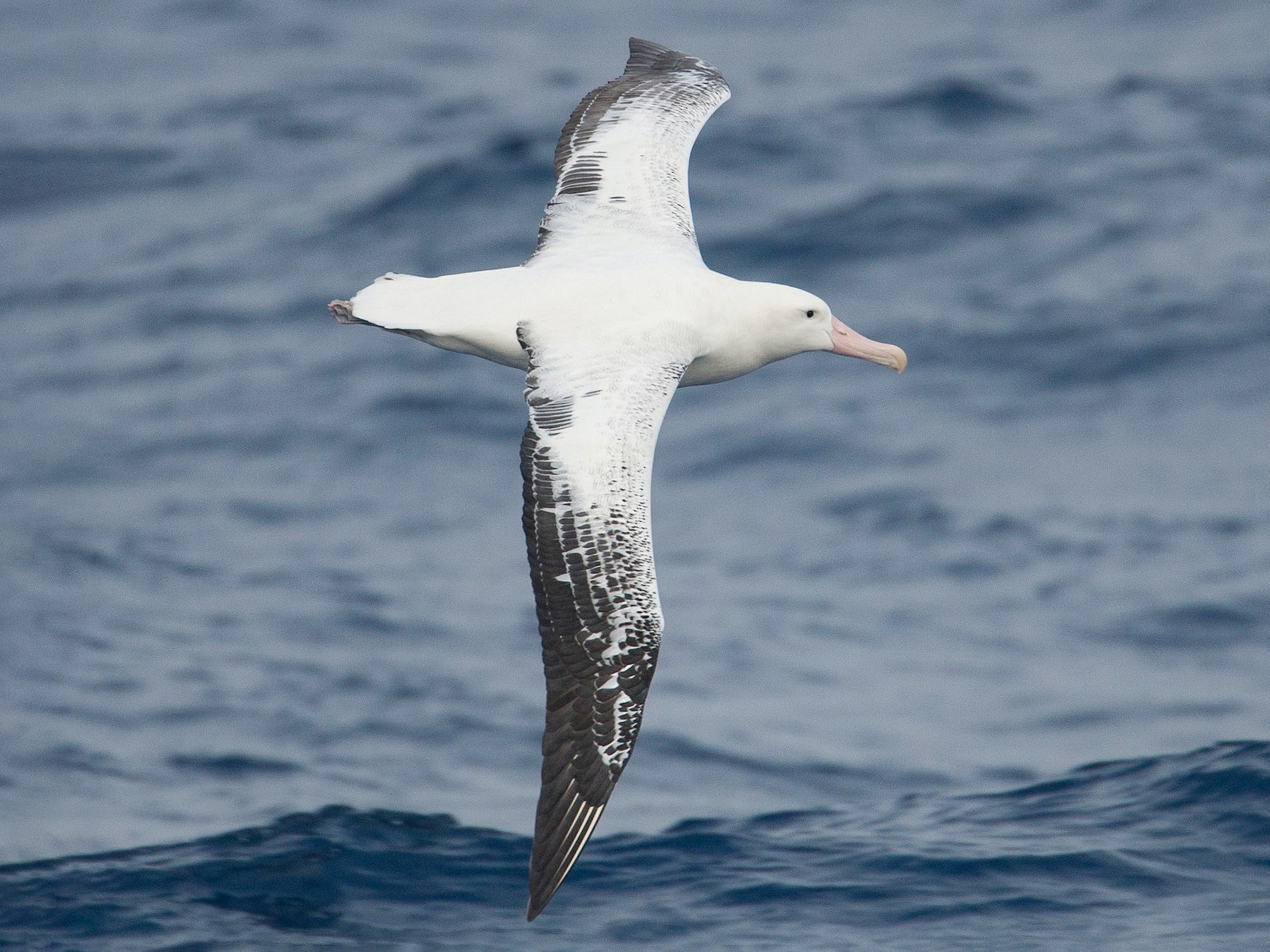
Main colonies of the snowy nest on South Georgia in the South Atlantic, and various islands in the southern Indian Ocean, but ranges extensively at sea. Plumage of the snowy is highly variable, starting chocolate-brown with a white face and gradually becoming whiter over many years. Younger birds separated from Southern Royal Albatross by darker tail, brown markings on head and back, and lack of black “lips” on cutting edge of bill. Older Snowy birds are much more difficult to separate; as a birdwatcher it is key to focus on more coarsely marked upperwings, often with conspicuous white patch in center of wing, and lack of black “lips.” Wandering Albatross, other than the Southern Royal bird, often show an orange stain on cheek. Identification from other Wandering-type Albatross, especially “Gibson’s” Antipodean and Tristan, is extremely difficult and often presumed by range. Adult male Snowy is the whitest of any Wandering Albatross, but intermediate ages often best left unidentified. [2]
Besides South Georgia Island, the Snowy albatross breeds on Crozet Islands, Kerguelen Islands, Prince Edward Islands, and Macquarie Island, is seen feeding year-round off the Kaikōura Peninsula on the east coast of the South Island of New Zealand, and ranges in all the southern oceans from 28° to 60°. Some individual Snowy albatrosses are known to circumnavigate the Southern Ocean three times, covering more than 120,000 km (75,000 mi), in one year. Snowy albatrosses spend most of their life in flight, landing only to breed and feed. Distances traveled each year are difficult to measure, but one banded bird was recorded traveling 6,000 km (3,700 mi) in twelve days.
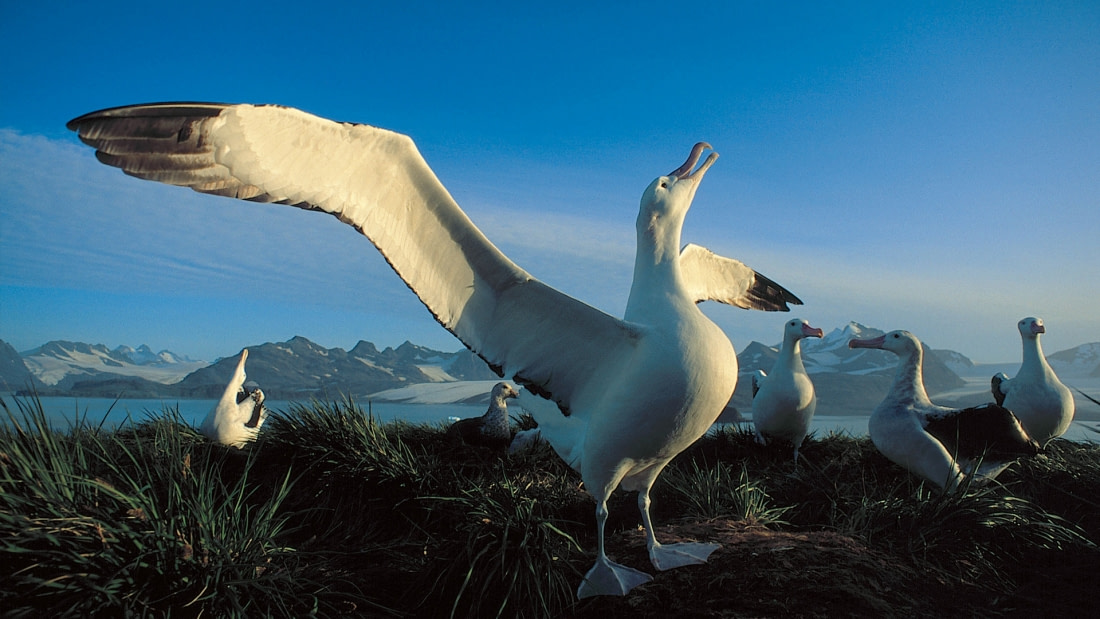
Snowy Albatross (Diomedea exulans)
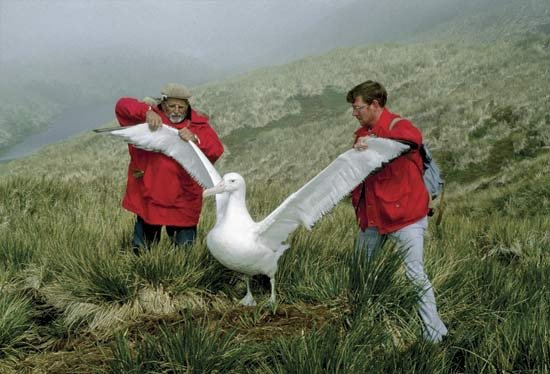
Doing some digging, it turns out that the Snowy Albatross (Diomedea exulans) has the longest wingspan of any living bird, including the Andean Condor. The albatross’s wingspan reaches upwards of 3.5 meters (11 ft), with a mean span of 3.1 meters (10 ft 2 in). [1]
Interestingly, there was an article in the New York Times about albatrosses citing the roosting of an elderly Laysan Albatross. Named Wisdom, she is the oldest known breeding bird in scientific history. Wisdom is approximately 74 years old and still laying eggs. [3] Wisdom, is expected to welcome another baby chick in the coming months, astonishing scientists who have been tracking her since the Eisenhower administration.

The NYT article states: “Wisdom laid an egg on Nov. 27 on Midway Atoll, a speck of land in the Pacific Ocean, the U.S. Fish and Wildlife Service said. Researchers said they were optimistic that it will hatch in about two months, making her a mother for the 30th or so time. Her last chick hatched in 2021.”
Scientists have long marveled over Wisdom’s longevity and her ability to breed as she gets older.”
“Jonathan Plissner, a supervisory wildlife biologist at Midway Atoll National Wildlife Refuge, told BBC Radio 4 on Wednesday that “it’s very rare” for a bird of Wisdom’s age to lay an egg, noting that ‘the average age that birds can survive is probably closer to 30 years.’ The next oldest albatross that researchers are aware of at Midway Atoll is about 45 years old, he said.”
“She is unique,” Dr. Plissner said. “We don’t know of any others that are even close to her age.”
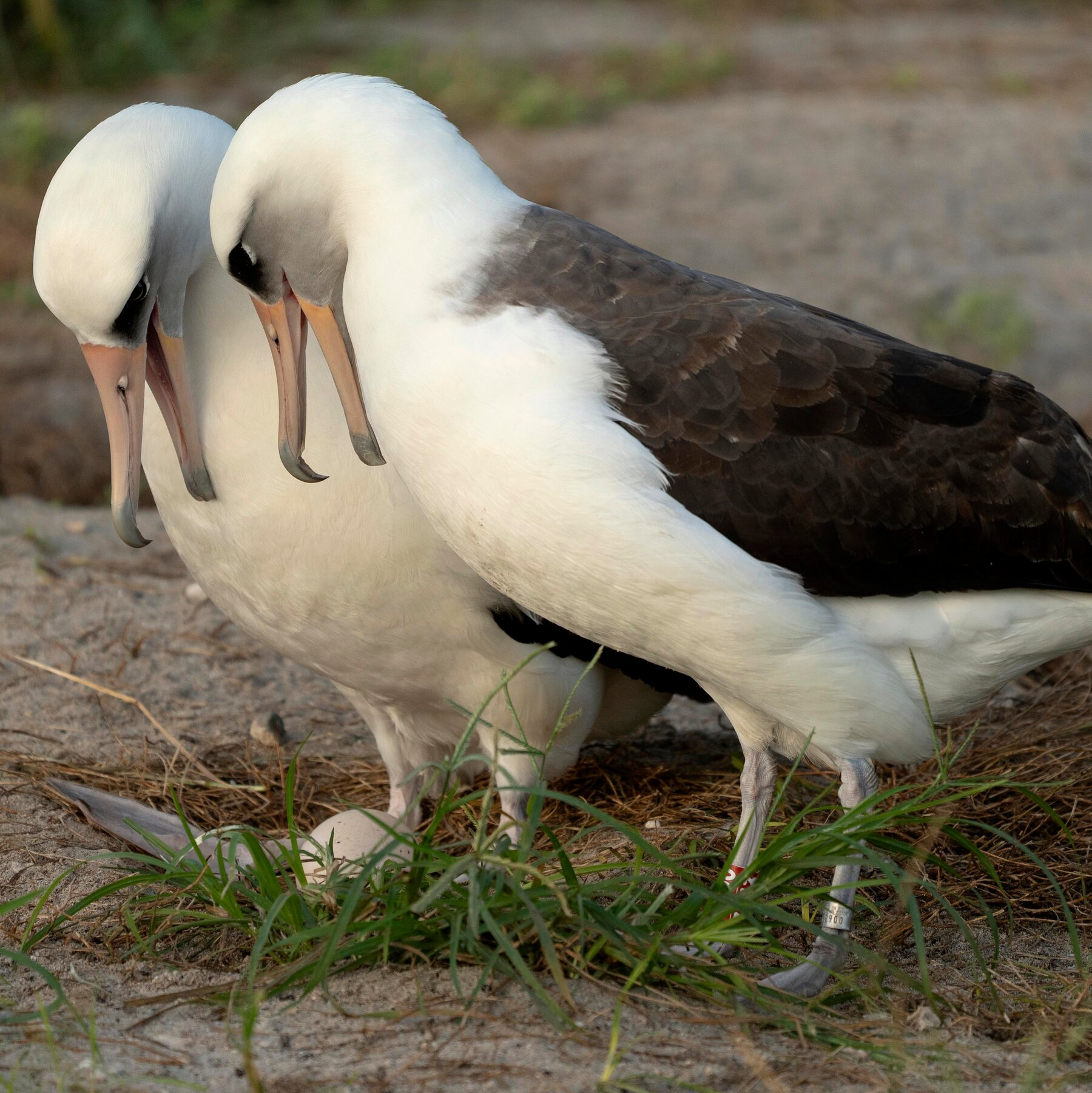
“Researchers at the wildlife refuge found that Wisdom had returned on Nov. 26 to Midway Atoll, about 1,200 miles northwest of Honolulu — and the site of one of the biggest battles of World War II, just a few years before she was born.”
“While albatrosses usually mate for life, they will find new mates to breed with if their partner dies. Dr. Plissner believes Wisdom has outlived at least three mates.”
“She hatched and raised chicks with another albatross named Akeakamai for decades, most recently in 2021, but Akeakamai has not been seen in several years. Wisdom’s new mate was outfitted with a tracking band last Friday. He stayed back to incubate the egg while Wisdom headed back to sea for a time, researchers said.”
“Birds can lay eggs late into life, although they may slow down as they get older. Albatrosses can lay only one egg a year, and Wisdom has laid about 50 to 60 eggs since researchers began tracking her in 1956, the Fish and Wildlife Service said on Tuesday. At least 30 chicks have hatched from those eggs and flown from the nest, Dr. Plissner said in the agency’s statement.”
“I think it’s impossible for us to look at that bird and not be stunned that she is still breeding and has laid an egg,” Dr. Carl Safina said.
“Most albatross eggs hatch in January or February, after about 65 days of incubation, according to the Fish and Wildlife Service. Chicks fly from the nest sometime in June or July after being fed regurgitated fish eggs and squid from their parents for several months.”
“She spends most of her life at sea, the Fish and Wildlife Service said. The researchers estimate she has flown about 3.7 million miles” in her lifetime.
“Wisdom has outlived Chandler Robbins, the well-known ornithologist who first banded her in 1956. He died in 2017.”
“Albatrosses don’t begin laying eggs until they are about 5 years old. Because Wisdom was originally found on a nest, researchers at the time estimated that she had to be at least 5 years old, but her exact age is not known, Dr. Plissner said.”[3]
===========================================
[1] According to measurements made on Bird Island, South Georgia, Antarctica. Further wingspan measurements yielded an average of 3 meters (9 ft 10 in) in 123 birds measured off the coast of Malabar, New South Wales.
[2] https://ebird.org/species/wanalb1
[3] https://www.nytimes.com/2024/12/06/science/wisdom-albatross-bird-egg.html
 Henry E. Hooper